
History of Department
Considering the rapid, dynamic changes in the fields of education, medicine, and the health sciences, as well as the need for early, safe, and high-quality clinical training, there has been a necessity for students to be provided with an integrated educational setting that can simulate the real clinical environment and develop their skills. Thus, allowing for the achievement of learning outcomes in an effective and safe environment.
Accordingly, the Department of Najah Interprofessional Skills and Simulation (NISS) was established as a part of the Faculty of Medicine and Allied Medical Sciences in the 2025-2026 academic year as a specialized academic department focusing on organizing and advancing competency-based medical training. This enables the delivery of interactive educational programs based on simulation, the skills labs, and virtual reality (VR), allowing the effective integration of theoretical learning and hands-on application in a safe, supervised environment.
In addition, the Department has introduced advanced forms of professional development in the field, most notably the Micro-Credentials division, in cooperation with An-Najah Innovation Park. The Micro-Credentials division is designed to provide specialized training programs to develop competencies in the field in line with labor market needs, while promoting lifelong learning, innovation, and entrepreneurship.
Therefore, the NISS department provides a central platform to enhance the quality of clinical education and training at the Faculty of Medicine and Allied Medical Sciences by developing advanced simulation environments and training pathways that improve professional readiness, quality of care, and patient safety.
To be a leading university reference in safe clinical training, simulation-based education, and virtual reality learning, ensuring that students are graduated with clearly defined practical competencies, professionalism, and the capability to provide safe and high-quality care.
To offer a structured and high-quality training environment that is primarily dedicated to meeting the needs of medical students in acquiring practical and professional competencies in a competency-based manner, utilizing specialty skills laboratories, realistic simulation, and virtual reality, under qualified supervision, with appropriate skills assessment, and offering short accredited professional courses (Micro-Credentials) that meet the training needs of residents, specialists, and health professionals.
- Enhance Clinical Reasoning in a Safe Environment.
- Improve Confidence and Preparedness of medical students and reduce anxiety during clinical rotations.
- Promote Patient Safety and Error Recognition.
- Strengthen Interprofessional and Communication Skills.
- Integrate Evidence-Based Clinical Guidelines by ensure students practice using updated clinical algorithms, decision trees, and standardized patient care pathways.
- Support a professional development path that offers a range of short, accredited professional courses accessible to all.
- Skill Labs
- Simulation labs and Virtual Reality
- Micro-Credential
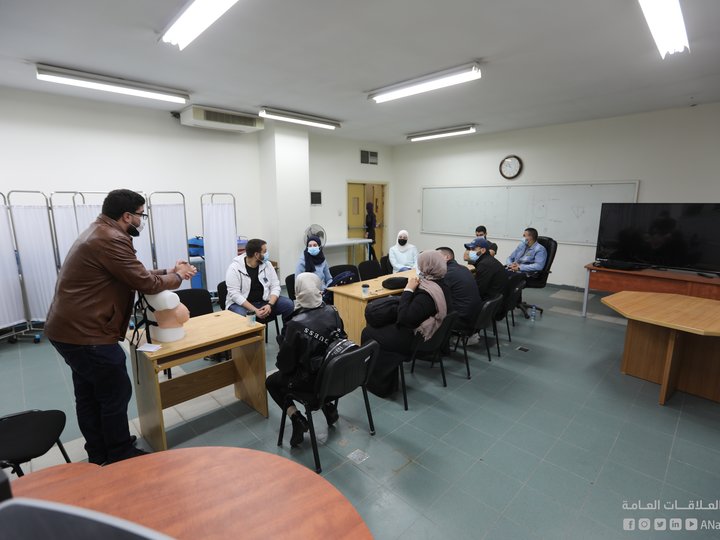
An-Najah National University's skills’ labs are dedicated to advancing health care provider education at all clinical levels.
Our goal is to achieve realistic, accurate, real-time medical simulation for acute medical conditions in life-like mannequins/trainers, allow students to develop clinical skill in a safe, controlled environment.
Skills labs are 5 halls found in the old campus containing large number of mannequins, beds and screens. These halls are used by medical students in different years practicing essential examination skills, including vital signs, abdominal and cardiovascular examination, etc.
The laboratories of the simulation center of the faculty of medicine and Allied Medical Sciences are one of the advanced practical laboratories to qualify and prepare students to be able to acquire medical and nursing skills, before application on real life, within hospitals and health institutions, so that integrates the theoretical side with the practical side. Thus, providing a clinical environment that simulates the environment of hospitals and health institutions through careful preparation of advanced laboratories equipped similar to those institutions that would contribute to raising the professional and technical performance of students of medicine, medical sciences and nursing and this is what drives the department strives to keep up with everything new updated.
This simulation center provides educational and training opportunities for all students that address medical and nursing students' real needs to improve their academic retention and success. Students of this department will experience a high quality educational and clinical training environment. What makes this simulation center unique is that it prepares and trains graduates to meet the needs and demands of the society as health leaders, caregivers, teachers/educators, advocators, and counselors. Besides, it makes productive and mutually beneficial relationships between the faculty and the community, higher education organizations, businesses, local schools, and regional colleges, and universities. Simulation center laboratory simulates a mini hospital, providing the medical and nursing students of all levels a safe training environment and allowing them to train for all kinds of situations that students will deal with them.
The simulation center is equipped with the highest-quality patients-mannequins and technology. It includes four separated classrooms serve as patients’ rooms, two control rooms, and two debriefing room as specified below:
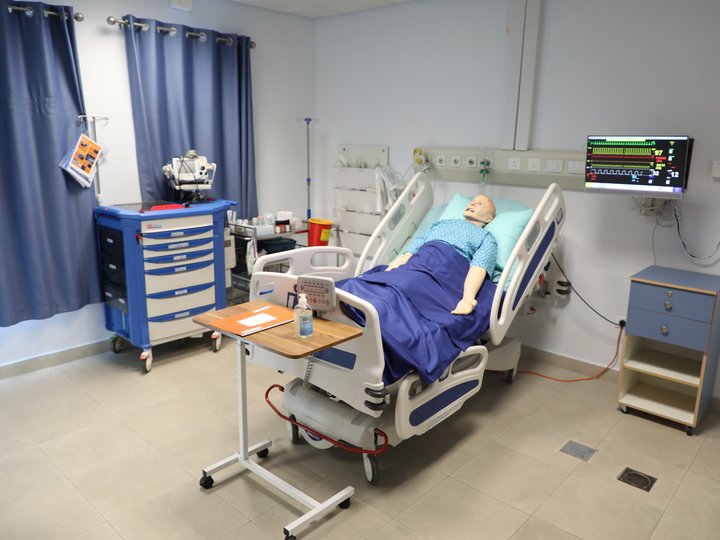
Adult patient simulation room fully equipped with two high-quality patient manikins with technology. These advanced and high-efficiency manikins allow applying all the medical nursing skills of each specialty, as they work with a wireless system and linked with control devices (tablets) to control and programming them in every possible scenarios and situation a student might face in the hospital or clinic and apply it safely before working in one.
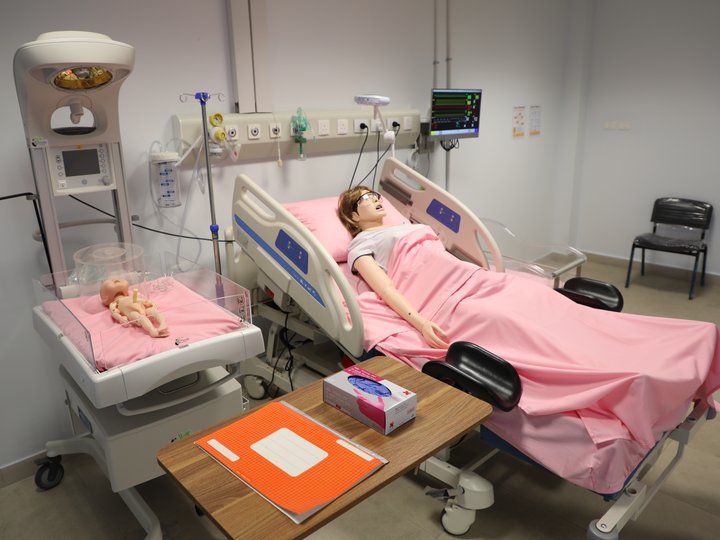
Mom / Female patient simulation room to serve as a labor, and gynecology unit fully equipped with two high quality patients’ manikins ( Mother & Baby ) , open heating system for the baby , with technology and these advanced and high-efficiency manikins allow applying all the medical and nursing skills of each specialty, as they work with a wireless system and linked with control devices (tablets) to control and programming them in every possible scenarios and situation a student might face in the hospital or clinic and apply it in a safe way.
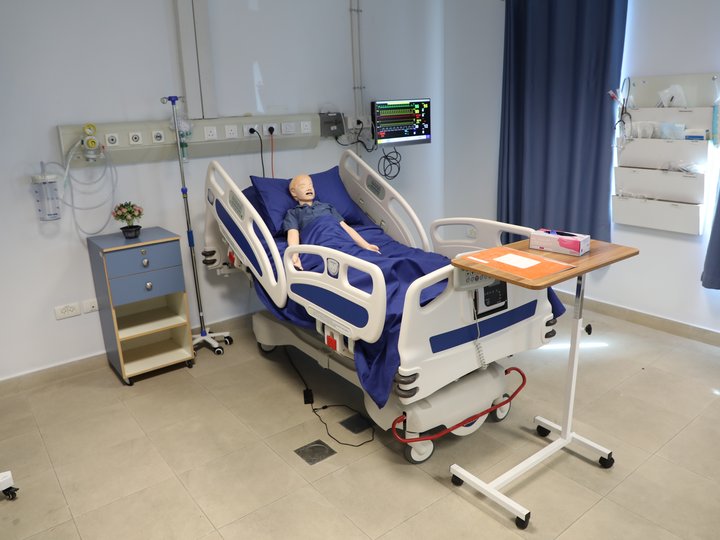
Junior patient simulation room to serve as a pediatrics unit , fully equipped with one high quality patients’ manikin, with technology ,these advanced and high-efficiency manikin allows applying all the medical and nursing skills of each specialty, as they work with a wireless system and linked with control devices (tablets) to control and programming them in every possible scenarios and situation a student might face in the hospital or clinic and apply it safely before working in one.
Debriefing rooms are fully equipped with 2 high-quality TV monitor, with a complete camera system (SMOTS) to monitor students’ work with patients in the rooms, transfer the image and sound to other students in the debriefing room, The debriefing allows the immediate feedback and a reflective critical thinking analysis and communication tool for participants of the simulation exercise. The purpose of the debriefing assessment provides an intense post-conference and active evaluation process driven by instructors and peers.
The students of all levels can apply all their basic and advanced medical and nursing skills during the training in the simulation center, such as full assessment of the patients , administering all types of medicine and a safe manner, inserting intravenous injection, administering intramuscular injection, applying the skills of ventilation, intubation , anesthesia, surgical procedures, giving medicines, inserting urinary catheter and stomach tube, hear the heartbeats and lungs sound, preform CPR and all other skills that can work with any patient in the hospital and apply Basic Life Support (BLS), Advanced Cardiovascular Life Support (ACLS) in accordance with American Heart Association Guidelines.

The Virtual Reality (VR) Laboratory is an advanced educational facility designed to teach and prepare medical and health sciences students at different levels to acquire and refine clinical skills in an interactive, realistic simulated environment before applying them in hospitals and healthcare institutions, thereby integrating theoretical learning with practical training through VR technologies and computer-based scenarios that simulate diverse clinical situations, enabling students to practice and make clinical decisions in a safe, supervised setting apart from the stress of real clinical environments.
The VR Lab also provides a high-quality training environment opportunities and evidence-based learning that helps build self-confidence, develop clinical reasoning and communication skills, and train students to manage scenarios they may encounter during clinical training and after graduation in real workplace settings.
VR Laboratory Facilities and Equipment
- VR headsets with controllers and motion sensors.
- Computer workstations and display screens to support group training and follow-up.
- Customizable simulation software and scenarios aligned with course objectives.
- A dedicated space for debriefing, reflection, and structured feedback.
The VR Laboratory includes a range of training stations and virtual scenarios that can be adapted according to courses and student level, for example:
- Outpatient clinic simulations: history taking, communication skills, health education/counseling, and building an initial assessment and management plan.
- Emergency and acute care simulations: assessment of acute cases, triage, managing sudden deterioration, and initial intervention steps.
- Structured clinical examination simulations: guided training on examination steps and linking findings to the clinical scenario.
- Diagnostic interpretation simulations: ECG interpretation, basic radiology imaging, and laboratory tests within the context of the case.
- Virtual practical exam stations (OSCE-style): training in station-based assessment formats with clear performance indicators and feedback.
The VR Laboratory enables students at all levels to practice essential and advanced skills safely and to a high standard, with a focus on building confidence, supporting active learning, and enhancing clinical readiness before participating in field-based clinical training.
